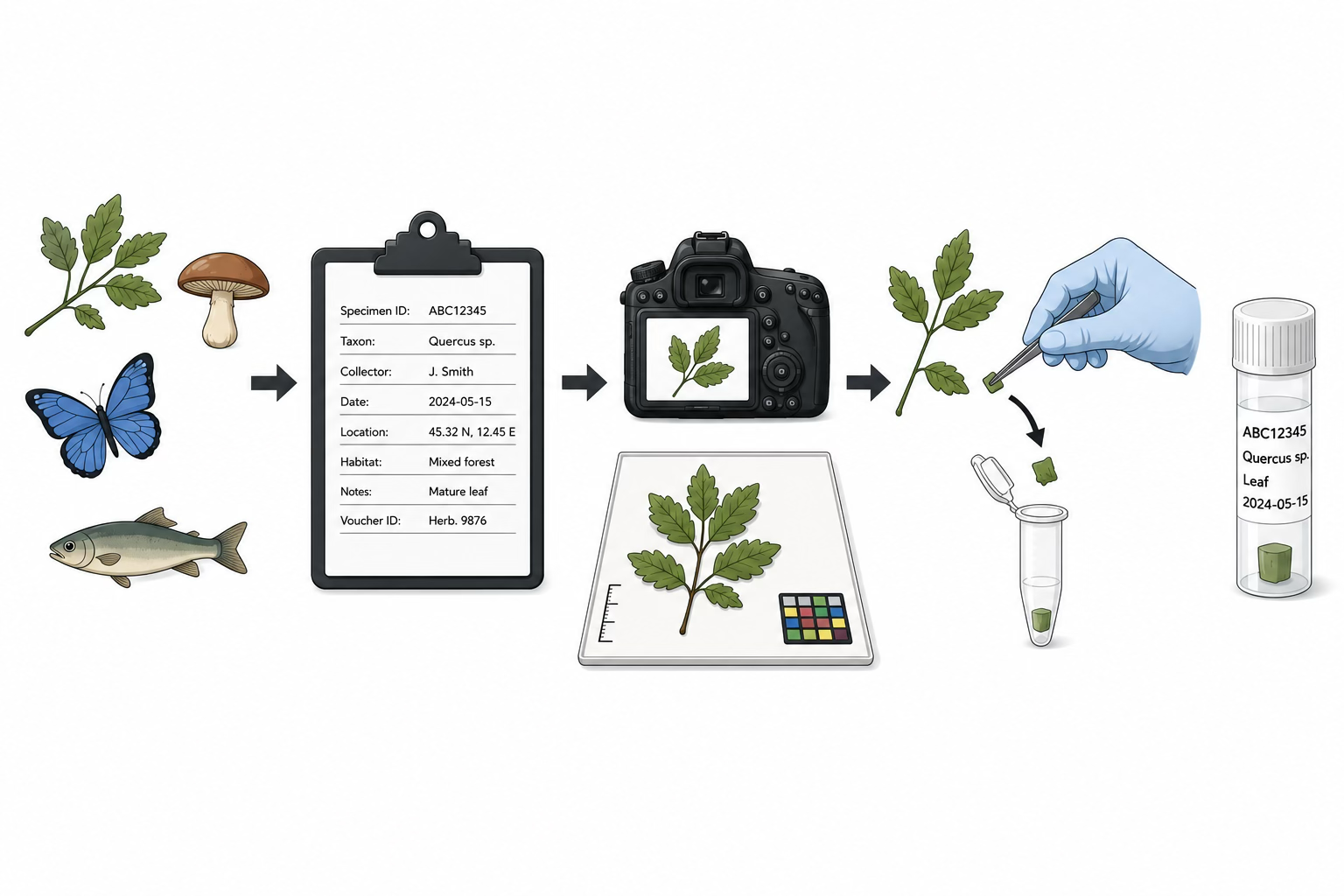
Sampling specimens for DNA barcode reference generation requires careful metadata collection, high-quality photographic documentation, and a laboratory workflow designed to minimise contamination. These elements are essential to ensure reference sequences are reliable, reproducible, and scientifically valuable.
In this online course, participants will learn the complete workflow for generating high-quality DNA barcode reference material. They will follow best practices for specimen handling and preservation in the field, including strategies to maintain DNA integrity and ensure traceability. The course covers how to accurately record and manage specimen metadata, as well as how to produce standardised, publication-quality images that support taxonomic identification. Participants will also learn laboratory considerations for handling specimens and sampling tissue in ways that reduce contamination risk. The last part of this training will focus on organising and preparing data for submission to the Barcode of Life Data Systems (BOLD), including metadata, images, and specimen records, as well as managing tissue collections for downstream molecular analysis.
The maximum number of participants is 20. In case of more applicants, participants will be selected based on the scientific, educational and/or professional merit, motivation and usefulness of the course for the applicants. Results of the selection process will be announced via e-mail shortly after the application deadline.
The course Sampling for reference DNA barcodes, organised within BGE+, will take place on Monday, 26 October, at 10:00 – 15:00 (CET) online. The registration deadline is 30 September.
Learning outcomes
By the end of the course, participants will clearly understand the practical and logistical steps required to build robust DNA barcode reference libraries on BOLD, from field collection to data submission. This includes:
- Preservation preferences for animal, plant and fungal tissue/specimens
- Long-term storage for DNA barcode reference vouchers
- Registration of metadata in standardised spreadsheets and upload to BOLD
- Photographic requirements and procedures for (bulk) image upload to BOLD
- Procedures for sequence QC and upload of sequence data to BOLD
Target group/Audience
PhD students and researchers who will use BOLD as a workbench for their DNA barcodes and other sequence data.
Language
English
Teachers
Torbjørn Ekrem – Professor, Department of Natural History, NTNU University Museum, Norwegian University of Science and Technology, Norway
Tomasz Mamos – Associate Professor, Department of Invertebrate Zoology and Hydrobiology, University of Lodz, Poland
Sónia Ferreira – Researcher, BIOPOLIS Program in Genomics, Biodiversity and Land Planning; CIBIO, Research Center in Biodiversity and Genetic Resources, InBIO Associate Laboratory, Portugal https://www.cibio.up.pt/en/people/details/sonia-ferreira/
Elisabeth Stur – Researcher, Department of Natural History, NTNU University Museum, Norwegian University of Science and Technology, Norway